
Analytics #КурсRUBT
Source @Tetris_Money • Published March 26, 2026
RUBT Rate on Tetris Money
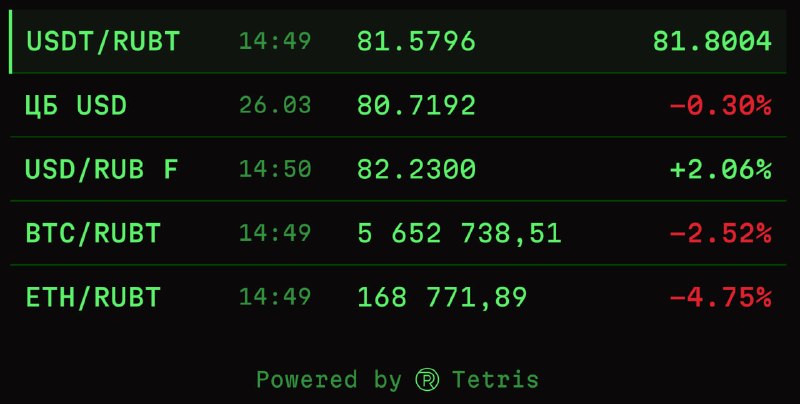
🟢 USDT/RUBT: 81.57 — Rate Board
🟢 USD/RUB (Bank of Russia): 80.71
🟢 USD/RUB F (MOEX): 82.23
🤔 What non-obvious factors could affect the rate in the future? Let’s break it down today:
🟢 VAT’s Inflationary Footprint
🟢 An “Overstrengthened” Anchor
🟢 Labor Shortage Against the Ruble
🟢 Digital Transformation of Settlements
🟢 Hidden Liberalization
Forecast and Summary
The medium-term trend points to a gradual weakening of the ruble. By mid-2026, analysts expect a move into the 85–90 ruble range, and by the end of the year — up to 94–100 rubles. Current levels around 80–81 for USDT/RUBT remain optimal for hedging risks ahead of the peak pressure in the second half of the year.
Swap on Tetris.Money
Contact the Team
Read the Blog
#RUBTRate
🟢 USDT/RUBT: 81.57 — Rate Board
🟢 USD/RUB (Bank of Russia): 80.71
🟢 USD/RUB F (MOEX): 82.23
🤔 What non-obvious factors could affect the rate in the future? Let’s break it down today:
🟢 VAT’s Inflationary Footprint
From January 1, 2026, the VAT rate increased to 22%, which has already added between 0.8% and 2% to annual inflation. This creates hidden pressure: the ruble’s purchasing power is declining faster than its nominal exchange rate is changing, which will inevitably lead to a correction in currency pairs toward a weaker ruble.
🟢 An “Overstrengthened” Anchor
According to analysts at VTB and Alfa-Bank, the current ruble exchange rate is 15–20% stronger than its “natural” level. This means that any easing of currency controls or a drop in oil prices could trigger a sharp rebound in the dollar to levels of 90–94 rubles.
🟢 Labor Shortage Against the Ruble
An unemployment rate of 2.2% has led to a systemic labor shortage. Wages in manufacturing and logistics are rising by 13–20%, outpacing labor productivity. This imbalance keeps inflation high, forcing the central bank to maintain the rate at 15%, but once the rate-cutting cycle accelerates, the ruble will lose its main advantage.
🟢 Digital Transformation of Settlements
From September 1, 2026, the mass rollout of the digital ruble begins. In parallel, the BRICS Pay system is launching, enabling cross-border payments without SWIFT and the dollar. This may reduce fundamental demand for “toxic” currencies, but in the short term, the restructuring of processes will create volatility in the USD/RUB pair.
🟢 Hidden Liberalization
The mandatory repatriation and sale requirement for foreign currency earnings is currently set to zero due to a temporary liquidity surplus. This gives exporters more freedom, but deprives the market of a stable inflow of foreign currency during periods of falling oil prices. If the exchange rate starts declining too quickly, the government may instantly reinstate the obligation to sell up to 90% of earnings.
Forecast and Summary
The medium-term trend points to a gradual weakening of the ruble. By mid-2026, analysts expect a move into the 85–90 ruble range, and by the end of the year — up to 94–100 rubles. Current levels around 80–81 for USDT/RUBT remain optimal for hedging risks ahead of the peak pressure in the second half of the year.
Swap on Tetris.Money
Contact the Team
Read the Blog
#RUBTRate