

Overview of the Ruble Digital Liquidity Infrastructure: Fact-Based Analysis of RUBT and A7A5 in…
Overview of the Ruble Digital Liquidity Infrastructure: Fact-Based Analysis of RUBT and A7A5 in 2026
The landscape of ruble-denominated digital assets in 2026 is characterized by the coexistence of diverse technological and legal models. The primary liquidity volumes are concentrated in two projects: the RUBT protocol by Tetris.money and the A7A5 stablecoin. This study analyzes these instruments through the lens of their architecture, economic efficiency, and regulatory status.
1. RUBT Protocol (Tetris.money)
The Tetris.money project positions RUBT as a specialized B2B infrastructure for instantaneous liquidity exchange between the ruble and USDT. The documentation emphasizes that RUBT is not electronic money or a bank deposit, but represents a digital right (monetary claim).
Operational Mechanism and Economics
The RUBT infrastructure implements a three-stage exchange cycle that separates fiat operations from crypto execution:
- Tokenization: A legal entity undergoes KYB and deposits rubles into a settlement account via a licensed Information System Operator (ISO) in the Russian Federation. RUBT tokens are credited at a 1:1 ratio.
- Decentralized Exchange: RUBT is exchanged for USDT via liquidity pools. Transactions are executed through smart contracts, ensuring atomicity.
- Reverse Cycle: The system allows for the conversion of USDT back into rubles for credit to bank accounts.
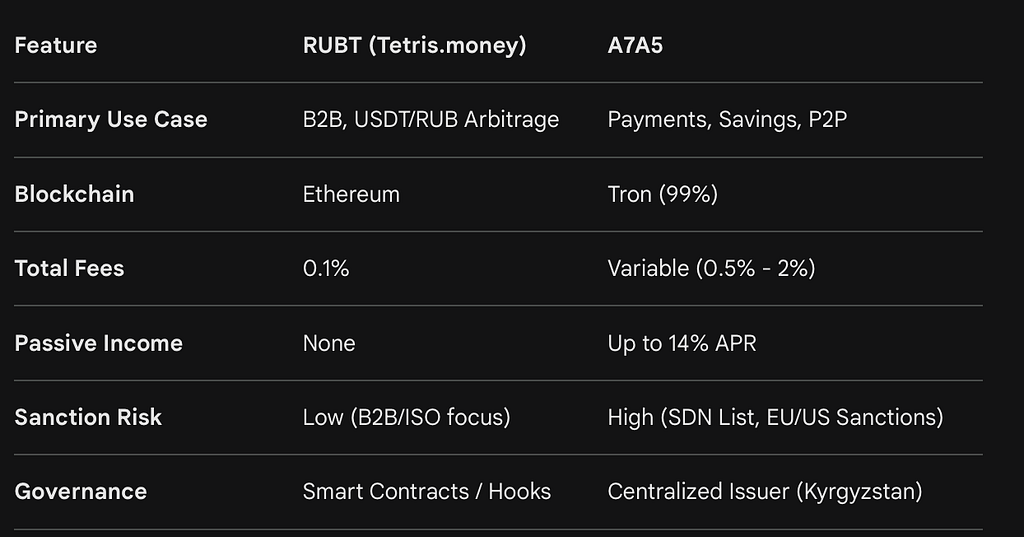
The total cost of the exchange cycle is 0.1%, which includes a conversion fee (0.05%) and a pool fee (0.05%).
Tech Stack and Transparency
- Uniswap V4: RUBT liquidity is integrated with Uniswap V4, enabling the use of Singleton architecture (all pools in one contract) and “Hooks” for dynamic adjustment of exchange parameters.
- Proof-of-Reserves: The protocol utilizes a reserve verification mechanism where an agent bank publishes reports on the availability of ruble collateral at a ratio of at least 1:1.
- Networks: The asset is represented on the Ethereum blockchain.
2. A7A5 Stablecoin
A7A5 is a ruble-denominated stablecoin oriented toward mass adoption as a means of payment and a savings tool. In 2025, the project captured approximately 43% of the global market for non-dollar digital currencies.
Scale and Operational Features
- Volumes: Aggregate transaction volume in 2025 exceeded $100 billion, with peak daily turnover reaching $1.5 billion. Approximately 99% of operations are conducted on the Tron network.
- Passive Income: The project model provides for the distribution of 50% of interest income from bank deposits among token holders. The declared yield is up to 14% per annum.
- Digital Promissory Notes: A unique system tool — physical securities with security layers and QR codes. These can be exchanged for cash rubles or foreign currency through partner offices and Telegram bots.
Regulatory Context
- DFA Status: In September 2025, the Bank of Russia recognized A7A5 as a Digital Financial Asset (DFA), legalizing its use by Russian exporters and importers for cross-border settlements under Federal Law №45-FZ.
- International Restrictions: The token and its issuer (Old Vector LLC) are subject to blocking sanctions by the US, UK, and EU (19th package). Article 5ba of EU Regulation №833/2014 introduced a direct ban on operations with the asset, leading to its delisting from major DEXs and the flagging of associated wallets by analytical systems (Chainalysis, TRM Labs).
- Legal Note: The issuer of the A7A5 stablecoin is Old Vector (or related entities of the A7 holding), registered and licensed in Kyrgyzstan. Since the asset is issued within the legal framework of that country and backed by deposits in partner banks under local regulation, any claims, transaction disputes, or lawsuits must be handled exclusively in the jurisdiction of the Kyrgyz Republic.
3. Comparative Characteristics of the Instruments
4. Legal Landscape in the RF (2024–2026)
Both assets operate within the updated legislation of the Russian Federation:
- Federal Law №259-FZ: Establishes the status of Digital Financial Assets. RUBT uses the qualification of a “monetary claim,” which avoids the asset being interpreted as “digital currency,” which is prohibited for domestic payments.
- Federal Law №45-FZ: Since March 2024, this law permits the use of DFAs and utilitarian digital rights as counter-performance under foreign trade contracts.
5. Summary
Analysis shows that the choice between these assets is determined by the nature of the user’s tasks. A7A5 is a highly liquid instrument with elements of passive income and a developed offline infrastructure (promissory notes); however, its use is limited by strict international sanctions and the risk of transactions being flagged as suspicious in global networks.
RUBT by Tetris.money represents a highly specialized B2B gateway. The project focuses on transparent compliance (KYB via ISO), minimization of trading costs (0.1%), and the use of advanced DeFi technologies (Uniswap V4), making it a resilient infrastructure solution for the corporate sector.